
Stock market volatility can make investors rethink where to put their money. When equity markets experience sharp movements because of geopolitical uncertainty, inflation, crude oil prices or changing interest-rate expectations, investors often ask an important question: Should you invest in equity, gold or fixed income?
There is no single answer that works for every investor. The appropriate investment strategy depends on factors such as financial goals, investment horizon, liquidity requirements and risk profile. Instead of reacting to short-term market movements, investors can consider diversification and strategic asset allocation as part of their long-term financial planning.
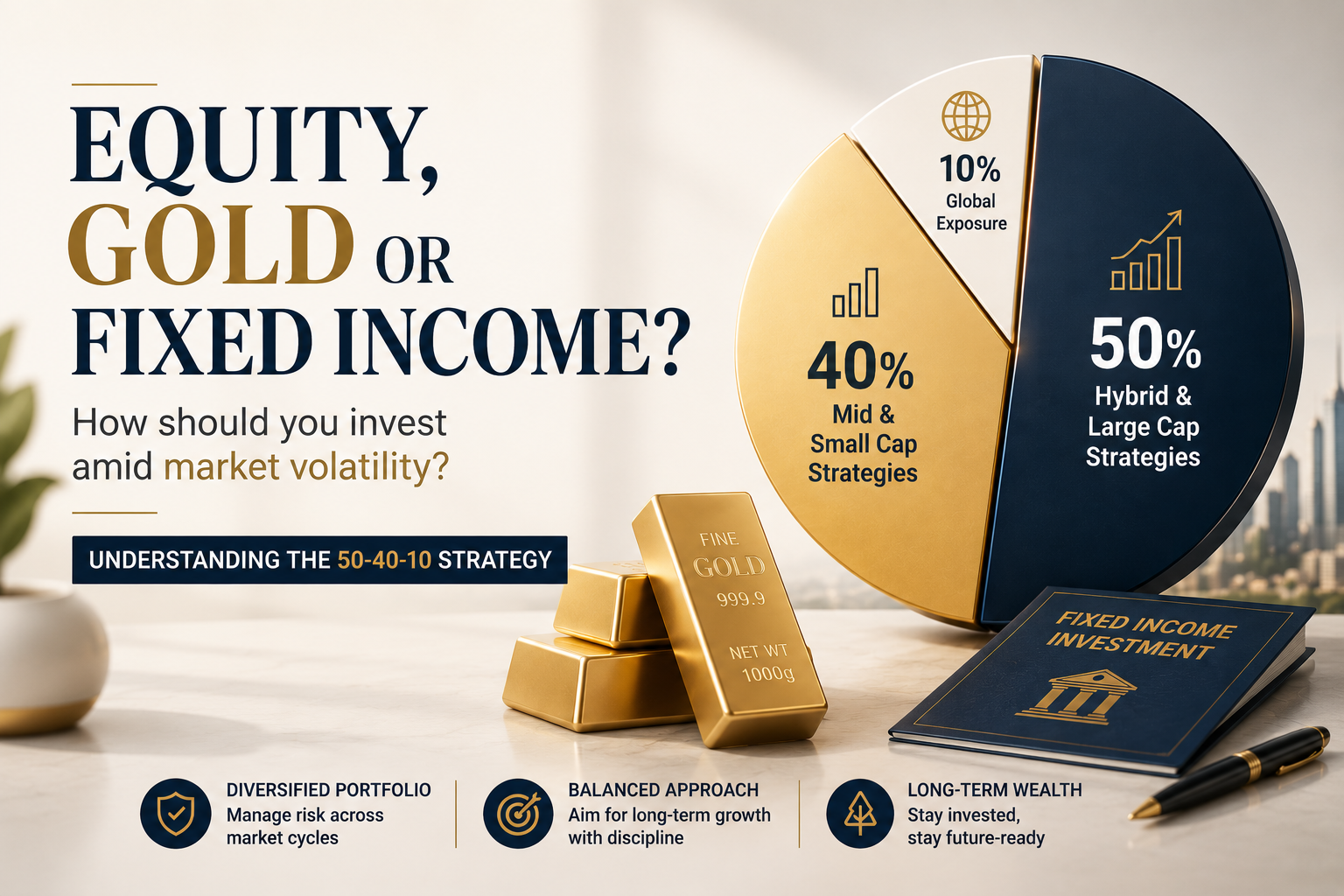
A strategy discussed by Motilal Oswal Private Wealth and reported by Mint in June 2026 provides one example of how a diversified portfolio can be structured. The approach discussed in the report broadly considers 50% in hybrid and large-cap strategies, 40% in mid- and small-cap strategies and 10% in global exposure. This is the firm’s stated approach and should not be interpreted as personalised investment advice or as a strategy suitable for every investor.
Why Is the Stock Market Volatile?
Stock market volatility can occur when investors respond to changing economic, political and corporate conditions. Geopolitical tensions, movements in crude oil prices, inflation concerns, currency fluctuations and expectations around interest rates can all influence market sentiment.
Global investment flows can also affect Indian equities. When foreign investors change their allocation towards emerging markets, equity indices can experience increased buying or selling pressure. Similarly, changes in corporate earnings expectations can influence the valuation of individual companies and broader market segments.
However, short-term volatility does not necessarily determine the long-term investment outlook. Investors should therefore distinguish between temporary market fluctuations and changes that could materially affect their long-term financial objectives.
Equity, Gold or Fixed Income: Which Should You Choose?
The decision between equity, gold or fixed income should generally begin with the investor’s objective rather than with recent market performance.
Equity investments are generally associated with long-term capital growth potential, but they can experience significant price fluctuations. Gold can provide diversification and may behave differently from equities under certain market conditions. Fixed-income investments may offer greater predictability of cash flows, depending on the product, while still carrying risks that investors need to understand.
Because these asset classes have different characteristics, combining suitable investments may help create a portfolio that is better aligned with an investor’s individual circumstances.
Understanding the 50-40-10 Investment Strategy
The 50-40-10 strategy discussed by Motilal Oswal Private Wealth is based on diversification across different investment categories. According to the report referenced by Mint, approximately 50% of the portfolio is considered for hybrid and large-cap strategies, 40% for mid- and small-cap strategies and 10% for global exposure.
The largest allocation towards hybrid and large-cap strategies can provide exposure to established companies and diversified investment approaches. Mid- and small-cap strategies can provide exposure to businesses with potential for long-term growth, although these segments can also experience greater volatility.
The global allocation can add geographical diversification by providing exposure to markets outside India. However, international investments can also involve additional risks, including currency movements, geopolitical developments and differences in market conditions.
The allocation percentages should not be treated as a universal formula. Every investor has different financial circumstances, and the appropriate asset allocation can vary significantly from one person to another.
Why Does Gold Matter in a Diversified Portfolio?
Gold is often considered a portfolio diversification asset. During periods of economic or geopolitical uncertainty, investor demand for gold can change significantly.
The Motilal Oswal Private Wealth report referenced in the original article maintained a neutral stance towards precious metals while expressing a relative preference for gold. The report cited continued central-bank buying and changes in speculative positioning as factors supporting its view.
However, gold prices can also fluctuate. Gold should therefore not automatically be considered a substitute for equity or fixed-income investments. Its role within a portfolio should depend on the investor’s objectives, existing investments and overall risk profile.
Why Consider Fixed Income During Market Volatility?
Fixed-income investments can form an important component of a diversified investment portfolio. Depending on the instrument, they may provide scheduled interest or coupon payments and a defined maturity structure.
For investors who want greater predictability in cash flows, fixed-income instruments may be relevant to their financial planning. However, fixed income does not mean risk-free. Corporate bonds, in particular, can involve credit risk, interest-rate risk, liquidity risk and other product-specific risks.
Investors should therefore evaluate the issuer, credit quality, maturity, interest rate or coupon, liquidity and applicable terms before investing in a corporate bond.
A higher stated yield should not by itself be interpreted as evidence that an investment is safer or more suitable.
Can Fixed Income Reduce Portfolio Volatility?
Fixed income can potentially help diversify a portfolio that has significant exposure to equities. Since different asset classes can respond differently to changing market conditions, diversification may help reduce dependence on the performance of a single investment category.
However, the degree of diversification and risk reduction depends on the specific investments selected. Bond prices can be affected by changes in interest rates, while corporate bonds may also be affected by changes in the financial strength of the issuer.
Therefore, investors should understand the characteristics and risks of the specific fixed-income product rather than viewing fixed income as a guaranteed protection against market losses.
Should You Stop Investing in Equity During a Market Correction?
A market correction does not automatically mean that investors should exit equities. Short-term market movements are difficult to predict consistently, and attempting to identify the exact market top and bottom can result in decisions that may not align with long-term financial goals.
Instead, investors can review whether their current asset allocation remains appropriate. If the portfolio has become significantly different from its intended allocation because of market movements, investors may consider reviewing the portfolio and, where appropriate, rebalancing it based on their financial plan.
Investors with a long investment horizon may have a different approach from investors who need their money in the near term. Consequently, the same market condition can require very different decisions for different individuals.
How Should Investors Approach Market Volatility?
One of the most important principles during volatile markets is to avoid making investment decisions purely because of short-term price movements.
Investors can begin by identifying their financial goals and the timeframe in which they may need the money. They can then consider how much market volatility they are financially and emotionally prepared to withstand.
Diversification can play an important role in this process. Equity may provide long-term growth potential, gold may provide portfolio diversification and fixed-income investments may provide greater predictability of cash flows depending on the instrument.
The objective is not necessarily to identify the investment that will perform best next. Instead, the objective is to create an investment approach that is consistent with the investor’s goals and risk profile.
Is the 50-40-10 Strategy Suitable for Every Investor?
The 50-40-10 strategy should not be viewed as a one-size-fits-all investment solution. The allocation discussed by Motilal Oswal Private Wealth represents one portfolio approach and does not account for the individual circumstances of every investor.
For example, an investor with a long investment horizon and a higher ability to tolerate volatility may have a different asset allocation from someone who is approaching retirement or has a significant financial requirement in the near future.
Similarly, investors considering fixed-income products should evaluate the specific security instead of relying only on the stated return or coupon.
Equity, Gold or Fixed Income: The Importance of Diversification
The question of whether to invest in equity, gold or fixed income does not necessarily require choosing only one asset class.
Each category can serve a different purpose within an investment portfolio. Equity can provide exposure to long-term economic growth, gold can provide diversification, while fixed-income investments can potentially provide more predictable cash flows depending on the product.
A diversified approach can help investors avoid becoming overly dependent on the performance of a single asset class. Nevertheless, diversification does not eliminate investment risk or guarantee positive returns.
Conclusion
Market volatility can be uncomfortable, but it can also be an opportunity for investors to reassess their financial strategy. Rather than making decisions based solely on short-term market movements, investors can focus on diversification, asset allocation, investment horizon and risk management.
The 50-40-10 strategy discussed by Motilal Oswal Private Wealth provides one example of strategic asset allocation, with approximately 50% in hybrid and large-cap strategies, 40% in mid- and small-cap strategies and 10% in global exposure.
At the same time, gold and fixed-income investments may have a role in a broader portfolio depending on an investor’s individual circumstances.
Ultimately, the right approach to equity, gold or fixed income depends on the investor. There is no universally appropriate allocation, and investment decisions should be based on financial objectives, risk profile, time horizon and an understanding of the risks associated with each product.
The goal of investing is not to predict every market movement. It is to build a strategy that is appropriate for your financial journey.
Disclaimer
This article is for educational and informational purposes only and should not be construed as investment advice, a recommendation, solicitation or an offer to buy or sell any securities or financial products. The 50-40-10 allocation discussed in this article is attributed to the investment approach reported by Motilal Oswal Private Wealth and is not a personalised recommendation. Investments in securities and financial products are subject to market and other risks. There is no assurance that any investment strategy will achieve its objective or generate any particular return. Investors should carefully review the relevant product documents, terms and risk factors and consider consulting a SEBI-registered investment adviser before making investment decisions.
Source
This article has been independently rewritten for educational purposes based on information originally reported by LiveMint in its article published on 4 June 2026. The views and investment strategy mentioned belong to the respective source and are not necessarily the views of Vedika Finance.