













Mutual funds are categorized based on their investment objectives and asset allocation strategies. Understanding these categories helps investors choose schemes that align with their financial goals, risk tolerance, and investment horizon.
Equity mutual funds invest primarily in shares of listed companies and focus on long-term capital growth by participating in stock market opportunities across different company sizes and sectors.
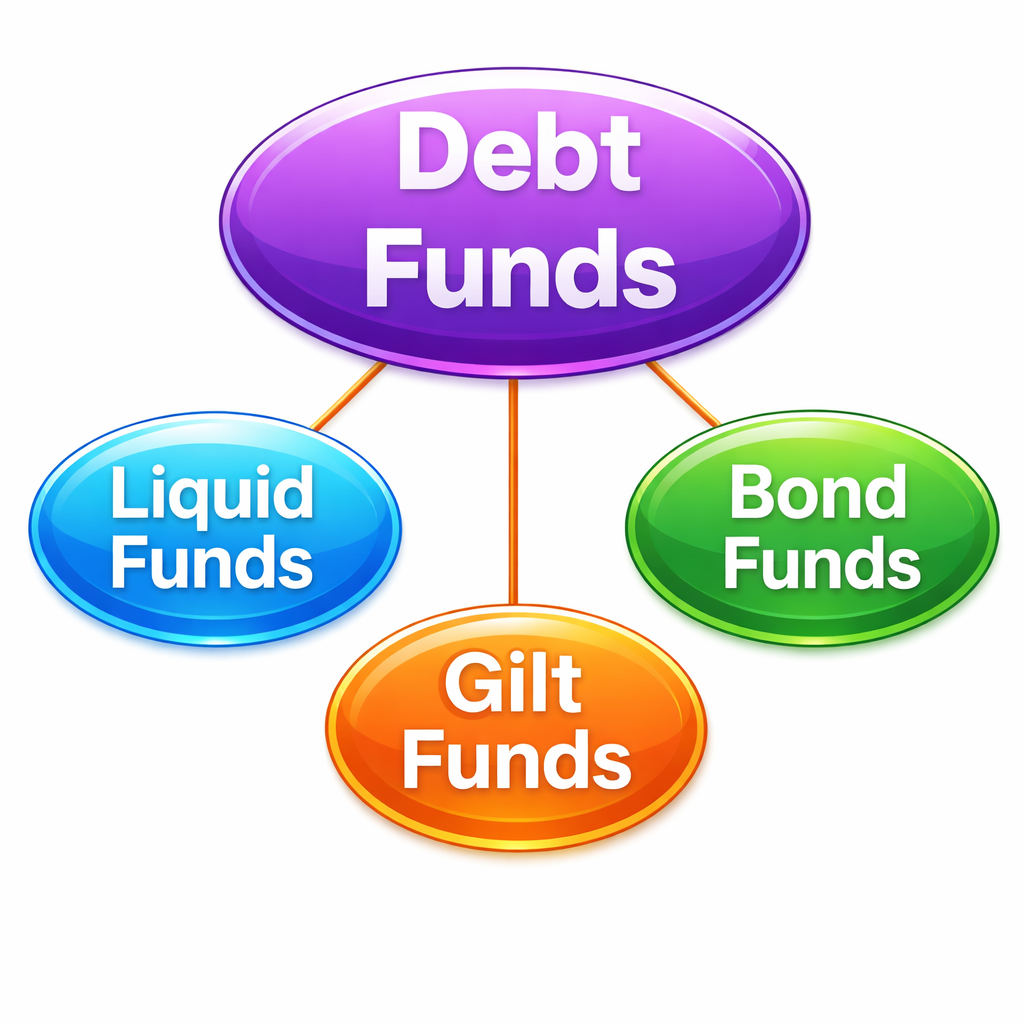
Debt mutual funds invest in fixed-income instruments issued by governments, corporations, and financial institutions. These schemes aim to generate stable returns through interest-bearing securities with varying maturity periods.
Hybrid mutual funds invest in a mix of equity and debt instruments to balance growth potential and stability. Allocation between asset classes varies depending on the investment strategy.
Solution-oriented funds are designed for specific long-term financial goals such as retirement planning or children’s education. Some schemes may have predefined lock-in periods to encourage long-term investing.
Index funds aim to replicate the performance of a specific market index such as Nifty or Sensex by investing in the same securities included in that index.
Exchange Traded Funds are investment schemes traded on stock exchanges like shares. They track indices, commodities, or baskets of securities and can be bought or sold during market hours.
A Fund of Funds invests in units of other mutual fund schemes instead of directly investing in securities. This approach allows investors to gain diversified exposure through a single investment.
Sectoral and thematic funds focus on specific sectors or investment themes such as banking, technology, or infrastructure, allowing investors to participate in targeted market opportunities.
Begin your financial planning by defining clear goals, selecting suitable investment options, and setting an appropriate investment horizon. Regularly review your investments to adapt to changing income, financial needs, and market conditions.

Contact No : +91 7360080140
Email: info@vedikafinserv.com